


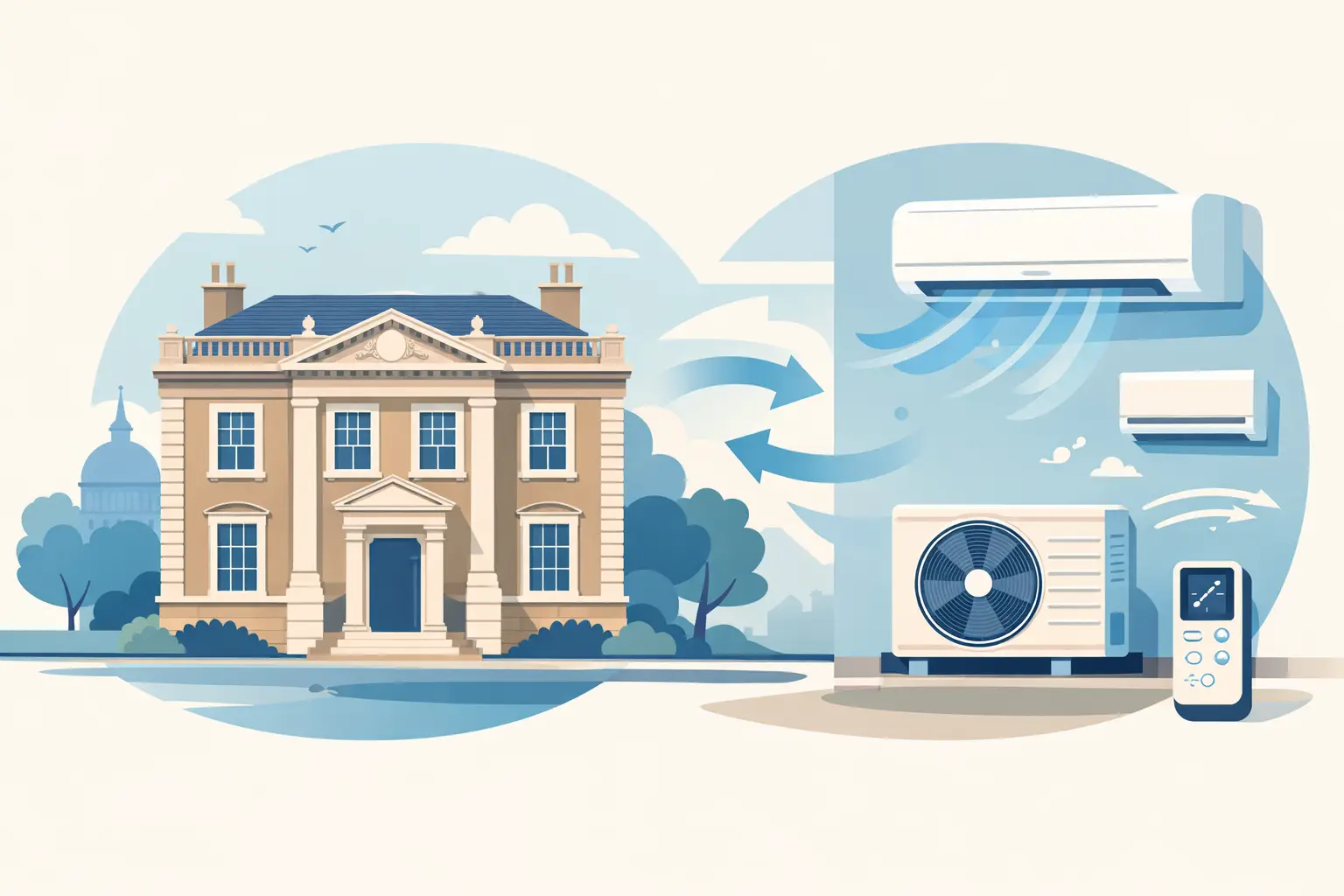
A listed building can be one of the hardest places to cool well. You may be dealing with thick walls, restricted window changes, heritage features that cannot be disturbed, and a planning process that does not allow shortcuts. That is why air conditioning for listed buildings needs a different approach from a standard house or office fit-out.
In London, the challenge is rarely just technical. It is usually a mix of comfort, compliance, appearance and practicality. Homeowners want relief from overheating without affecting historic interiors. Landlords need works that protect the asset and avoid problems with tenants or freeholders. Commercial occupiers need reliable cooling for staff, customers or equipment, but cannot risk an installation that breaches listed building controls.
Why listed buildings need a specialist approach
With a modern property, air conditioning design is often driven by cooling load, pipe routes, condenser position and budget. In a listed building, those factors still matter, but they sit alongside heritage constraints that can change the whole design.
External units may be limited by visibility from the street, roofline impact, noise concerns or planning objections. Internal routes for pipework and condensate drainage may be restricted because decorative plasterwork, original timber, stonework or historic joinery must be preserved. Even small penetrations through walls can become sensitive if the building fabric is protected.
That means the best solution is not always the most obvious one. A powerful wall-mounted split system might be simple on paper, but if it requires prominent external plant or visible trunking across original features, it may be the wrong choice. In listed properties, good design starts with what the building can realistically accommodate.
Is air conditioning allowed in a listed building?
Sometimes yes, sometimes no, and often it depends on how the system is designed and where it is installed.
Listed status does not automatically prevent air conditioning. What it does mean is that changes affecting the character of the building may require listed building consent, and in some cases planning permission as well. The exact answer depends on the grade of listing, the location of the equipment, the visibility of any external changes, the route of services, and the significance of the areas being altered.
In London, boroughs can take slightly different positions in practice, especially in conservation areas or where neighbouring properties are close. A rear elevation condenser that may be acceptable in one setting could raise concerns in another. That is why generic advice is risky. Site-specific assessment matters.
For leasehold flats, there can be another layer. Even if the local authority is supportive, the freeholder or managing agent may restrict external units, roof access, fixing methods or service routes through communal parts. The legal and practical side need checking together.
The best types of air conditioning for listed buildings
There is no single best system for every heritage property. The right option depends on layout, visibility, planning risk, required cooling performance and how much intervention the building can tolerate.
Split systems
Split systems are often suitable where one or two rooms need cooling and there is a discreet position for the outdoor unit. They work well in bedrooms, home offices, reception rooms, small retail spaces and single occupied offices. The indoor unit can be wall-mounted, floor-mounted or, in some cases, concealed.
The issue is usually not whether a split system can cool the space. It is whether the outdoor unit can be placed in a location that is acceptable from both a planning and visual point of view. Rear courtyards, screened terraces and less prominent service areas can sometimes make this possible.
Multi-split and VRF or VRV systems
For larger homes, offices or mixed-use buildings, a multi-split or VRF or VRV system may be the better route. These systems allow several indoor units to connect to fewer outdoor units, which can reduce external clutter and help with plant coordination.
That said, more complex systems need more careful pipework planning. In older buildings with tight risers, protected interiors or awkward structural routes, system complexity must be balanced against installability. The smartest system on paper is not helpful if access is too intrusive.
Concealed indoor units
Where appearance is a priority, concealed ducted units or other low-visibility indoor solutions can be worth considering. These can reduce visual impact within high-value or historic interiors, but they need ceiling voids, joinery integration or service zones that not every listed building has.
This is one of those areas where trade-offs matter. A concealed system can look cleaner, but it may require more building work than a visible unit placed carefully. In some heritage settings, less intervention is actually the better option.
Design decisions that matter most
Air conditioning in a listed building succeeds or fails on design detail. Capacity is important, but so are the quieter factors that get missed early on.
Noise control is one. Outdoor plants must be considered not just for neighbours but for courtyards, mews settings and enclosed rear spaces where sound can reflect. Low-noise equipment, anti-vibration measures and sensible siting can make the difference between a compliant system and one that creates complaints.
Condensate drainage is another. In heritage properties, you cannot assume there will be an easy gravity drain route. Pumped drainage may be needed, but that introduces maintenance and access considerations. Pipe runs must be planned early, not improvised during installation.
Visual impact also matters inside the property. Trunking across ornate walls or visible services through original rooms will rarely be ideal. A careful survey can often identify routes through cupboards, secondary spaces, service corners or less sensitive fabric. This is where experience with older London buildings is particularly valuable.
Planning, consent and compliance in London
For many clients, this is the part that causes the most uncertainty. They are not just asking, can air conditioning be installed? They are asking, can it be installed without creating a planning problem or damaging the building?
The sensible route is to review the property before any equipment is specified as final. That means understanding the listing constraints, checking whether external alterations are likely to trigger consent, identifying any lease or landlord restrictions, and producing a design that has a realistic path to approval.
Compliance is not only about planning. Installation standards, electrical works, refrigerant handling, commissioning and documentation all need to be managed properly. In commercial settings, maintenance access and long-term serviceability should be considered from the outset. A system hidden too well can become difficult and expensive to maintain later.
For that reason, a specialist London contractor should be looking at the whole lifecycle, not just the initial install. Air conditioning in listed buildings must be discreet, but it also has to remain practical to service safely and efficiently.
What a site survey should cover
A proper survey for air conditioning for listed buildings goes beyond measuring room sizes. It should assess heat gain, orientation, occupancy patterns, electrical capacity, likely indoor unit positions, external plant options, pipe and drain routes, noise sensitivities and access constraints.
Just as importantly, it should flag heritage and approval risks before the job moves too far. If a preferred condenser location is likely to be refused, that is better identified at the survey stage than after a quote has been accepted. Clear advice at the start saves time, cost and frustration.
For London properties, survey findings often shape the project more than the equipment brochure does. Two near-identical buildings can need very different solutions because one has a concealed rear elevation, while the other faces tighter visual controls and lease restrictions.
Common mistakes to avoid
The first mistake is treating a listed building like any other installation. That often leads to poor unit positioning, unrealistic assumptions about permissions, and avoidable disruption.
The second is choosing equipment before the building strategy is clear. Clients sometimes focus on a specific brand or unit style too early, when the bigger issue is whether the required services can be routed properly and approved.
The third is underestimating maintenance. Filters need cleaning, condensate systems need checking, and the plant needs safe access. Even in a sensitive property, the system should still be serviceable without major disturbance.
A practical way forward
If you are considering air conditioning in a listed home, office, shop or hospitality space, the best first step is not to pick a unit online. It is to arrange a survey that looks at the building, the likely planning position and the cooling requirement together.
That approach gives you realistic options rather than generic promises. In many cases, a compliant and discreet solution is possible, but it usually comes from careful system selection, tidy routing, low-visibility placement and a contractor who understands London property constraints. That is exactly where a specialist, such as an air conditioning specialist in London, adds value.
A listed building asks more from an installer, but it does not have to rule out comfort. With the right design, cooling can be introduced in a way that respects the property as much as the people using it.