
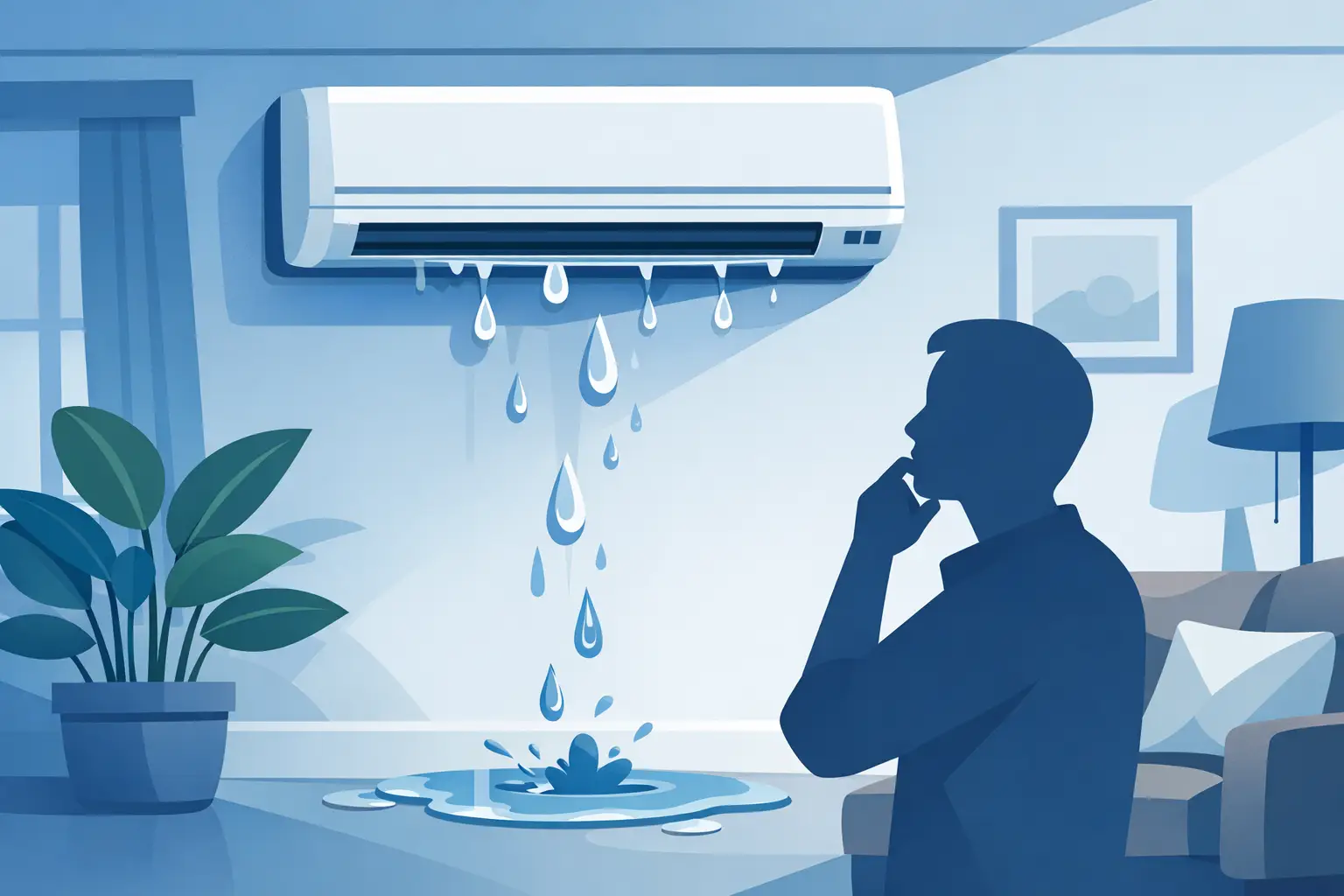
A puddle under an indoor unit is never something to ignore. If your air conditioning leaking water indoors has started suddenly, the issue is often minor at first, but it can quickly lead to stained walls, damaged ceilings, wet flooring and disruption to your home or business.
In London properties, this problem can be more complicated than it looks. A wall-mounted split unit in a flat, a cassette system in an office ceiling, or a VRF indoor unit in a retail space can all leak for different reasons. Access can also be tighter in converted houses, listed buildings and managed commercial premises, which makes early diagnosis more important.
Why air conditioning leaks water indoors
Air conditioning does not only cool the air. It also removes moisture. As warm indoor air passes over the evaporator coil, condensation forms and should drain safely away through a condensate tray and pipework. When that process is interrupted, water ends up where it should not.
The most common cause is a blocked condensate drain. Dust, biofilm and debris can build up in the drain line over time, especially where routine servicing has been missed. Instead of flowing outside or into the designated waste connection, the water backs up into the unit and spills indoors.
A dirty filter can also contribute. Restricted airflow can cause the evaporator coil to become excessively cold, which may lead to icing. When that ice melts, the drain system can be overwhelmed and water may drip from the front of the unit or overflow from the tray.
Low refrigerant is another possibility. If refrigerant levels drop because of a leak, coil temperatures can fall below normal operating range and create ice. Again, once the system cycles off or thaws, that water has to go somewhere. This is one of the reasons a leak indoors should not be treated as a simple housekeeping issue. Sometimes it is a symptom of a cooling fault rather than a drainage fault.
Air conditioning leaking water indoors – the most likely faults
Although the visible symptom is the same, the underlying fault can vary quite a lot.
A blocked or partially blocked drain line is the usual starting point. In residential split systems, this can happen gradually and show up as occasional drips before becoming a steady leak. In offices or shops, cassette units may start staining ceiling tiles before anyone notices an actual drip.
A cracked drain tray is less common but does happen, particularly in older systems or units that have seen years of vibration and temperature changes. If the tray is damaged, condensate may escape even when the drain line itself is clear.
Poor installation can also be the issue. If the drain pipe has been run without the correct fall, or if the indoor unit is not level, water may not move through the system as intended. In London, where installations often need to work around structural constraints, boxed-in routes and limited service voids, correct pipework design matters more than many property owners realise.
Frozen coils, dirty filters and fan-related airflow problems are another category. If not enough warm air passes across the coil, condensation behaviour changes and excess water can develop during thawing. This tends to point back to maintenance rather than a one-off incident.
Then there is the condensate pump. Some installations, especially where gravity drainage is difficult, rely on a pump to move condensate away. If that pump fails, the unit may leak indoors even though the drain route itself is otherwise fine. This is particularly relevant in basement spaces, internal rooms and certain commercial fit-outs.
What you should do straight away
First, switch the system off. That limits further water build-up and helps protect electrical components. If water is close to lights, sockets, ceiling fittings or other electrics, keep clear and arrange a professional inspection promptly.
Next, protect the area below the unit. Towels, a shallow tray or temporary floor protection can reduce damage while you assess the situation. In commercial premises, this is also a health and safety issue. Wet floors in offices, retail spaces or hospitality venues can create a slip hazard very quickly.
If the filter is accessible and clearly dirty, remove it and check its condition. Some light dust can be cleaned, but if the filter is heavily clogged, that already tells you servicing is overdue. Do not start dismantling panels or trying to force water through the drain unless you know the system well. It is easy to turn a drainage problem into a damaged unit.
When a leak is a maintenance issue and when it is a repair issue
This is where it depends. Not every indoor leak means a major fault, but not every leak is solved by a basic clean either.
If the problem is a blocked drain or neglected filter, a proper service may resolve it. That usually involves cleaning the filters, checking the coil, clearing the condensate line, inspecting the tray and confirming that the unit is draining correctly in operation.
If the system has low refrigerant, a failed pump, a damaged tray, poor pipework falls or icing linked to component failure, that moves into repair work. Refrigerant faults in particular need correct testing, leak tracing and F-Gas compliant handling. Topping up without identifying the cause is not a proper fix.
For landlords and commercial operators, this distinction matters because a recurring leak can damage finishes, disrupt tenants or staff, and increase longer-term repair costs. Acting early is usually cheaper than waiting for the next drip to become a ceiling repair.
Why this happens so often in London properties
A standard national answer rarely covers the realities of London buildings. Indoor units are often installed in tight positions, pipe runs may be longer or more awkward, and drainage routes can be limited by layout, leasehold restrictions or the need to preserve the appearance of a listed or conservation-area property.
In flats, condensate routing may depend on very specific installation choices. In offices and retail premises, ceiling voids can hide slow leaks for weeks before they become visible. In hospitality settings, a leak is not just a maintenance annoyance – it can affect customer areas and operational continuity.
That is why diagnosis should not stop at the symptom. A contractor needs to understand how the unit was installed, how the drainage was designed, and whether the problem is being caused by the property constraints around the system rather than by the unit alone.
Can you keep using the system?
Usually, no. If your air conditioning leaking water indoors, continued use is a risk. Even if cooling still seems normal, water can track into walls, ceilings, flooring and electrical areas. A small drip today can become hidden moisture damage tomorrow.
There are exceptions where a unit has only produced a minor drip and the cause is immediately obvious, but in most cases the sensible approach is to stop using it until it has been checked. This is especially true for cassette units above suspended ceilings, where the visible leak may be less than the actual water collecting above.
How a professional diagnoses the problem
A proper inspection should look at more than the water mark on the wall. The engineer should check filters, coil condition, drain tray, drain line, unit levelling, refrigerant performance and, where fitted, condensate pump operation.
For commercial systems, diagnosis may also involve checking multiple indoor units, shared pipework routes or controls behaviour. With VRF and VRV systems, one symptom at a single indoor unit can sometimes relate to a wider system condition rather than a stand-alone fault.
At Air Conditioning in London, this sort of fault finding is approached with the property type in mind as well as the equipment. That matters when access is restricted, finishes need protecting, or the drainage route has been adapted to suit planning or building constraints.
How to reduce the chance of it happening again
The simplest answer is regular servicing. Most indoor leaks are easier to prevent than to repair. Filters need cleaning, drain lines need checking, coils need inspection and pumps need testing where installed.
For homes, an annual service is often enough, although heavier summer use can justify more frequent attention. For offices, shops, server rooms and hospitality spaces, maintenance schedules should reflect how critical the cooling is and how many hours the system runs.
If a unit has leaked more than once, ask for the installation details to be reviewed rather than just the symptom being treated. A recurring drainage fault can point to poor falls, awkward routing or an underspecified pump. Those issues do not improve on their own.
If you have noticed air conditioning leaking water indoors, treat it as an early warning rather than a nuisance. A quick, professional check can often prevent more expensive damage and get the system back to safe, reliable operation with minimal disruption.